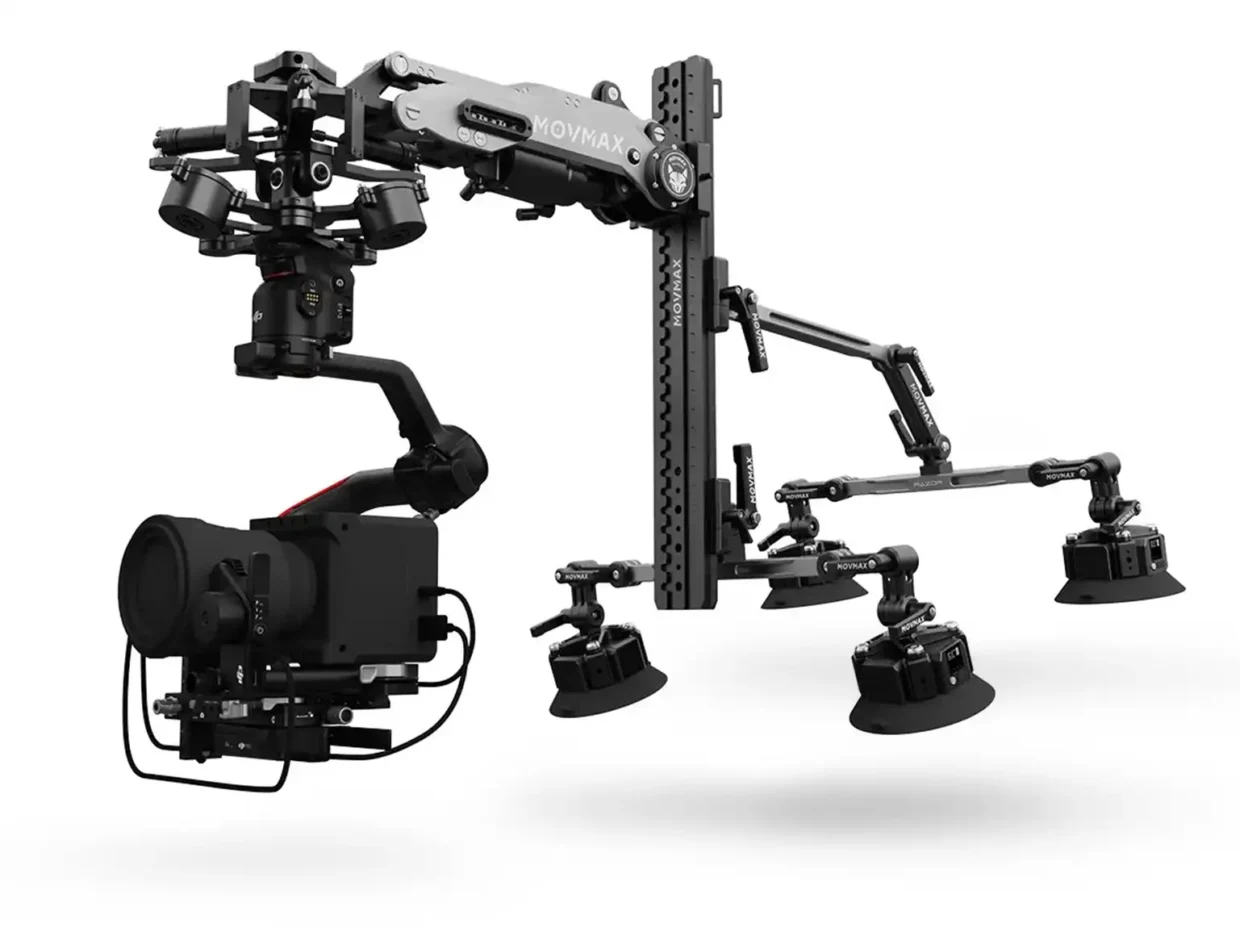
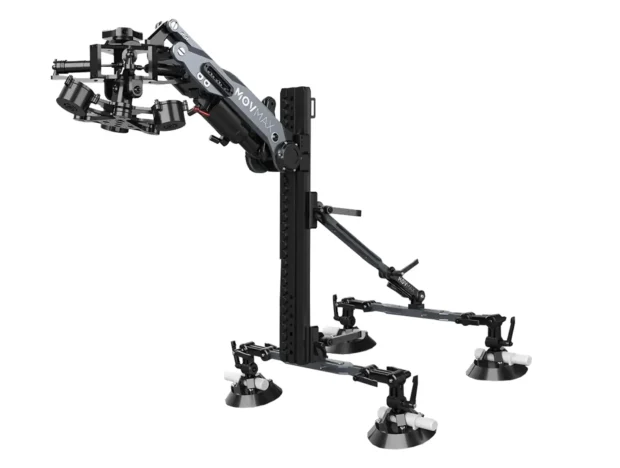
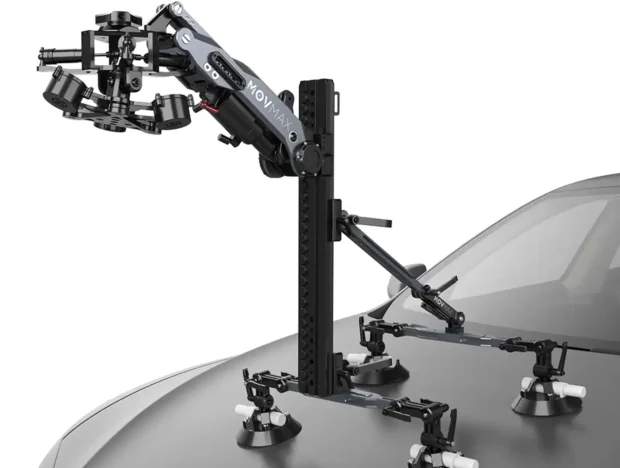
The MOVMAX Razor Arm is a compact vehicle camera stabilisation system designed to reduce vibration and vertical movement during tracking shots. It combines an adjustable shock-absorbing arm with suction-cup mounting, vibration isolation and support for DJI RS-series gimbals. A practical option for car-to-car filming and low-profile vehicle rigs without stepping up to a much larger arm system.
Overview
- Designed specifically for moving vehicle camera work and dynamic tracking shots.
- Adjustable arm system helps reduce unwanted vibration and vertical movement from the vehicle.
- Supports camera and gimbal payloads up to approximately 6.5kg.
- Uses multiple IMT suction cups for flexible mounting across suitable vehicle surfaces.
- Includes a dedicated vibration isolator between the arm and camera system.
- Compatible with DJI RS-series gimbals including RS 2, RS 3 Pro, RS 4 and RS 4 Pro with the appropriate mounting setup.
- Compact compared with larger vehicle-mounted suspension arms, making it useful for smaller camera packages and quicker builds.
- V-Mount power integration allows the gimbal and camera setup to be powered as part of the vehicle rig.
Use Cases
- Car-to-car tracking shots for commercials, drama and factual productions.
- Low-angle vehicle rigs where a handheld gimbal alone would transmit too much road vibration.
- Compact pursuit-camera setups using mirrorless or lightweight cinema cameras on DJI RS-series gimbals.
1x Movmax Dovetail Sliding Plate
1x Movmax Star Vibration Isolator
1x Movmax Suction Cup Bracket (Long)
1x Movmax Suction Cup Bracket (Short)
1x Movmax Nato Rail
1x Movmax Power Supply Base Plate
1x Movmax V-Mount Sliding Plate
1x D-Tap to 2-Pin Lemo Cable
1x Movmax Safety String Bracket
1x Ratchet Tie-Down Strap
1x Movmax Inflator
1x Movmax Razor Arm Case
Keep the camera package light.
The Razor Arm performs best with compact gimbal builds. Avoid adding unnecessary accessories, oversized lenses or large batteries directly to the moving payload.
Balance the gimbal before mounting it.
Get the camera mechanically balanced on the DJI RS first, then mount the complete gimbal package onto the Razor Arm. This avoids adding unnecessary load to the gimbal motors.
Set the arm for the actual payload.
The spring and damping behaviour should be adjusted around the combined weight of the camera, lens, gimbal and accessories rather than the camera body alone.
Use the vibration isolator properly.
The suspension arm handles larger vehicle movement, while the isolator deals with higher-frequency vibration. Both parts of the system need to be correctly set up to get the best result.
Choose solid mounting surfaces.
Suction mounts rely on a clean, smooth and structurally sound vehicle surface. Avoid weak panels, heavily curved sections or damaged paintwork where possible.
Always use secondary safety.
Vehicle camera rigs should be independently safety-secured even when every suction cup is holding correctly. The Razor system includes dedicated safety-string hardware for this purpose.
Recheck suction throughout the day.
Temperature changes, contamination and vehicle vibration can affect suction over time, so inspect and pump the mounts regularly between takes.
Test the route before shooting.
Different road surfaces can change the behaviour of the arm dramatically. A short rehearsal helps establish damping, gimbal settings and driving speed before committing to the shot.
Do not treat payload rating as a target.
Although the system is rated up to around 6.5kg, a lighter package generally gives the suspension and gimbal more headroom to deal with bumps and acceleration.